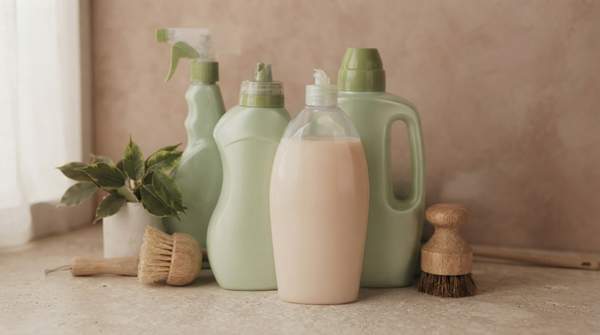
You do not need a curated list of "best green brands" to build a non-toxic home. You need a repeatable way to interrogate the bottle in front of you. The United States Environmental Protection Agency puts the problem plainly: consumers should be careful interpreting vague or generic claims like "environmentally friendly," "eco safe," or "green" — claims the agency itself flags as "greenwashing." The reliable alternative, according to the EPA, is to look past the label language toward ingredients, packaging, and third-party verification. This guide builds that into a three-part framework you can apply to any household cleaning brand.
Beyond Greenwashing: Your Framework for Eco-Friendly Cleaning
Greenwashing thrives on vagueness. A bottle that promises to be "eco safe" has told you almost nothing about its surfactants, its plastic, or whether anyone outside the company checked its claims. The EPA's own guidance is that generic environmental claims should not be taken at face value, and its Safer Choice program exists precisely because the agency recognizes how hard it is for purchasers to identify greener cleaning products on their own.
The framework that follows asks three questions of any brand. First: what is in the product, and how honestly does the company describe it? Second: what happens to the packaging when the product is gone? Third: who, beyond the marketing department, has verified any of it? Each question filters out a different kind of hype, and together they let you decide which values matter most to you — rather than accepting a reviewer's ranking as your own.
Evaluating Ingredient Safety and Transparency
Ingredient safety starts with knowing what the hazards actually are. The EPA identifies specific concerns in conventional cleaning products: many surfactants biodegrade slowly, or biodegrade into chemicals that are more toxic, persistent, and bioaccumulative — a particular threat to aquatic life. Ingredients containing phosphorus or nitrogen can contribute to nutrient-loading in water bodies, though the agency notes these contributions are typically small compared to other sources. Volatile organic compounds, or VOCs, affect indoor air quality and contribute to smog formation outdoors.
The agency's sustainability yardstick is minimal presence of, and minimal exposure to, potentially harmful chemicals — including corrosive or strongly irritating substances. That standard gives you a concrete screen. When a brand discloses its full ingredient list, check it against these categories. When a brand hides behind "proprietary blend" or an unspecified fragrance, that opacity is itself a finding. Transparency is not the same as safety, but a company that will not tell you what is in the bottle has already failed the first test.
Assessing Packaging Sustainability
Packaging is where a genuinely eco-conscious brand proves it, because refill systems require infrastructure and commitment that a label change does not. Refillable and concentrated products reduce plastic waste by design: as Good Housekeeping UK's testing of refillable cleaning products observed, concentrated solutions mean a small amount goes a long way, you stop repeatedly buying new plastic bottles, and the smaller containers are easier to store. Those outlets also note a practical side effect — the long-lived bottles most refill brands design tend to be made attractive enough to sit out on the counter.
Two qualifications matter here. Refill systems only cut waste if you actually use them repeatedly, so availability of refills where you shop is part of the evaluation. And "recyclable" on a label describes what a package is made of, not what your local facility accepts. A brand that sells concentrate you decant into a bottle you already own, or offers refills in widely recyclable formats, is doing more verifiable work than one relying on a green-tinted bottle.
Decoding Third-Party Certifications
Certifications are how you outsource trust. The EPA manages the Safer Choice program, which certifies products containing ingredients the agency judges safer for human health and the environment — a rigorous evaluation of chemical ingredients rather than a marketing seal. For antimicrobial products such as disinfectants and sanitizers, the agency offers its Design for the Environment (DfE) label.
The practical rule: a certification is worth what the certifier is worth. A government program with published ingredient criteria, like Safer Choice, tells you something about the product's chemistry. A vague badge with no named organization behind it tells you something about the marketing instead. When a brand claims third-party testing or accreditation, the name of the certifier and what it actually certifies should be findable — if it is not, count that as a failed third test.
Your Eco-Friendly Cleaning Product Decision Framework
Here is the three-part test as a working matrix. For any cleaning product you are considering, work through each row, record what the brand claims, and note whether a verifiable source — the label's disclosure, the EPA's program, or an independent reviewer — supports it. The final column preserves the honest caveats that keep the framework from becoming its own overclaim.
| Evaluation area | Key criteria | What to look for | Qualification |
|---|---|---|---|
| Greenwashing screen | Identifying misleading claims | Treat "environmentally friendly," "eco safe," and "green" as signals to investigate, not facts to accept | These claims are not necessarily supported by verifiable standards |
| Ingredient safety | Verifiable standards | The EPA Safer Choice label, indicating ingredients evaluated as safer for human health and the environment | Certification reflects a rigorous evaluation of chemical ingredients |
| Ingredient hazards to check | Known risk categories | Slow or toxically biodegrading surfactants; phosphorus/nitrogen nutrient-loading; VOCs; corrosive or strongly irritating substances | Per the EPA, cleaning products' water-quality contributions are typically small compared with other sources |
| Packaging sustainability | Waste reduction | Refillable bottles with concentrates you dilute at home, reducing repeated plastic purchases | Effectiveness depends on consumer adoption and refill availability |
| Brand example: Branch Basics | Ingredient and packaging claims | Fully biodegradable, fragrance-free, non-GMO products with natural ingredients; concentrate you add to water in a reusable bottle | Claims are based on product descriptions and user reviews, not independent lab testing |
| Brand example: ECOS | Ingredient and packaging claims | Biodegradable products with plant-derived ingredients; family-owned for more than 50 years; eco-friendly packaging and third-party testing claimed | Information derived from product descriptions and reviews |
Applying the matrix shows how it works in practice. Branch Basics scores well on the packaging test: its reviewer at The Good Trade describes filling a bottle to the waterline, adding concentrate, and shaking — a refill system that keeps one bottle in service. On the ingredient test, the products are described as fully biodegradable, fragrance-free, and non-GMO, with recognizable ingredients like baking soda and organic chamomile. Note, though, that this is the brand's own description, relayed by a reviewer who has used the products personally; it is a strong disclosure record, not a laboratory verification.
ECOS scores well on the transparency-of-record test: The Good Trade describes the company as family-owned and -operated for more than 50 years, listing biodegradable formulas, plant-derived ingredients, eco-friendly packaging, and third-party testing among its attributes. What the framework then demands is the follow-up: which third party, testing for what, and is the Safer Choice label on the specific bottle you are buying? A brand's stated commitments are the start of the evaluation, not its conclusion.
Making Your Informed Choice for a Non-Toxic Home
Apply the three-part evaluation framework — ingredient safety, packaging sustainability, verifiable claims — to new cleaning products before purchase. That is the whole method: interrogate the ingredient list against the EPA's hazard categories, ask whether the packaging is designed to be refilled or genuinely recycled, and confirm which named certifier stands behind any seal.
One caveat belongs in any honest conclusion: this framework cuts through marketing claims, but it does not replace independent lab testing or a comprehensive lifecycle assessment of any product. What it does replace is guesswork. The measure of success is concrete — the ability to articulate specific, evidence-backed reasons for choosing or rejecting a product, rather than relying on vague "green" claims. The next time a bottle promises to be eco safe, you will know exactly which three questions to ask it, and you will be able to say, in one sentence, why it passes or fails your own test.
Sources
- Identifying Greener Cleaning Products — US EPA
- Say ‘no’ to plastic waste with our 15 best refillable cleaning products, tried and tested — Good Housekeeping UK
- I Tested 15+ Natural And Nontoxic Cleaning Products — The Good Trade