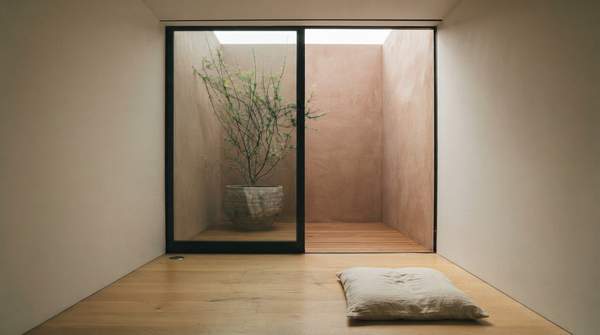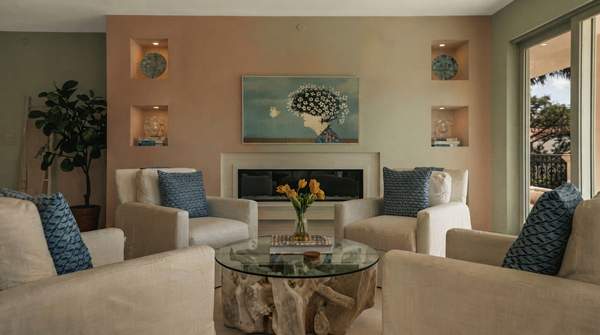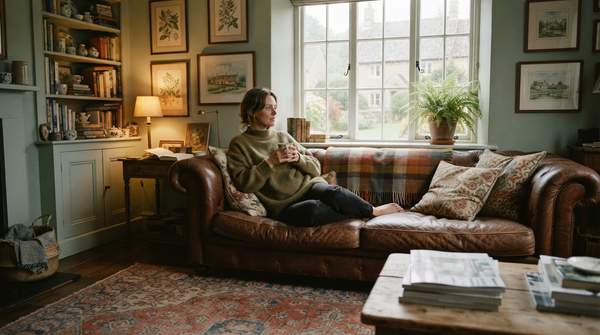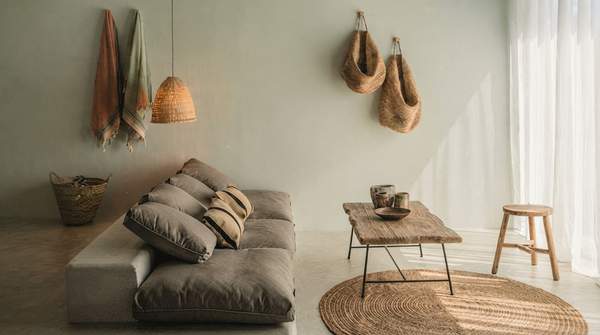
If you want a Wabi-Sabi home, the work is less about acquiring and more about choosing differently: raw natural materials like wood, stone, clay, and linen; spaces stripped to the essential; and objects whose cracks, fades, and worn surfaces are kept in view rather than hidden. Wabi-Sabi is a Japanese philosophy rooted in Zen Buddhism that, as author Beth Kempton describes in a lookbook curated by Dezeen's features editor Nat Barker, helps us "to see beauty in imperfection, appreciate simplicity and accept the transient nature of all things." Applied to interiors, it stands deliberately apart from the perfection-driven design habits most of us have absorbed.
Understanding Wabi-Sabi: A Philosophy of Imperfection
Before it is a look, Wabi-Sabi is a mindset. The philosophy is one of several traditional Japanese worldviews—alongside Ma and Shakkei—that shape how homes are designed and lived in, and it traces its cultural roots to Shintoism and Buddhism, which promoted Zen feelings of inner peace, harmony, and selflessness. Where Western habits often push us to fix, replace, or disguise, Wabi-Sabi asks us to stop dwelling on imperfections in the first place.
That reframing is what makes the aesthetic feel serene rather than shabby. A student researcher writing on Japanese interior design for Connecticut College's Asian art collection observed that the philosophy "celebrates imperfections in objects as it showcases their history and character," noting that living with such pieces makes one less stressed over flaws and can add inner peace to daily life. The Interior Design Institute makes the same point from a design-education angle: Wabi-Sabi encourages us to find contentment in our environments as they are, which also happens to be a more sustainable way to live, since we stop chasing flawless newness.
Wabi-Sabi vs. Western Design: A Decision Framework
The clearest way to apply Wabi-Sabi is to see where it diverges from the conventional Western instincts most rooms are built on. The Interior Design Institute frames the philosophy as "increasingly resonant in today's fast-paced and perfection-driven world"—and that phrase, perfection-driven, is the hinge. The Western characteristics below are inferred as the opposite of what Wabi-Sabi embraces, so treat them as a mirror rather than a rulebook about every Western room.
| Dimension | Wabi-Sabi Design | Conventional Western Design |
|---|---|---|
| Core Value | Embraces imperfection, impermanence, and authenticity | Pursues perfection, newness, and manufactured precision |
| Treatment of Objects | Celebrates aging, wear, and natural flaws as part of an object's story | Aims to hide or avoid signs of age, wear, and imperfection |
| Material Preference | Favors natural, raw, organic materials—wood, stone, clay, linen | Often uses manufactured, polished, or synthetic materials for uniformity |
| Symmetry | Accepts asymmetry and the unplanned arrangement of things | Favors balanced, matched, and precisely arranged compositions |
| Color Palette | Soft, muted colors and natural, earthy tones | Often bolder, trend-led, or high-contrast schemes |
| Overall Goal | Fosters serenity, authenticity, inner peace, and connection to nature | Projects polish, currency, and visual impressiveness |
Use the table as a filter at the moment of choice. When you are holding an object or planning a layout, ask which column the decision belongs to: a cracked vase kept and displayed sits firmly in the left column; a flawless replacement bought to erase the crack sits in the right. That single question is what lets you consciously curate a Wabi-Sabi space rather than drift back into perfection-seeking by habit.